What gets people booked into the Miami-Dade jail in November?
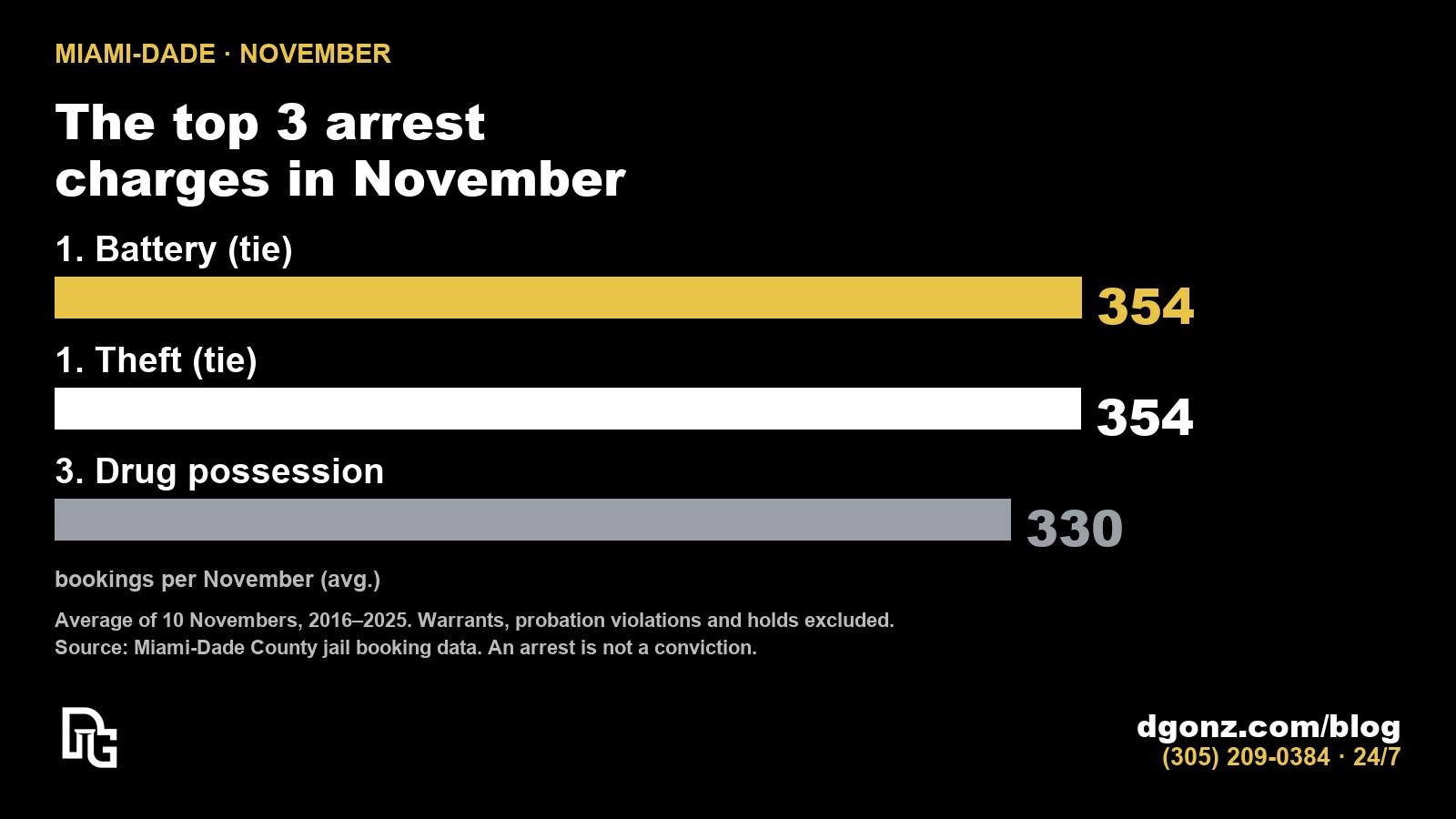
We checked 10 years of jail bookings. Averaged over those 10 Novembers, three charges lead: battery, theft and drug possession.
Here is what the numbers show, what each charge means, and how each one is defended.
What we looked at
We used Miami-Dade County's open jail booking data. We looked at the 10 full Novembers from 2016 through 2025. November 2026 is not over, so we left it out.
We left out warrants, bench warrants, capias, probation violations, agency holds and public-drinking charges. We also left out bookings with a homeless or transient address.
A booking can carry several charges. We counted each charge once per booking. We grouped the county's charge codes into families. The county changed its codes over the years, so we added the old and new codes together.
One more note. Our data only includes charge codes that reached a monthly top 20 at some point. So the family totals are a little low.
The top 3, averaged over 10 Novembers
| Rank | Charge family | Average per November |
|---|---|---|
| 1 (tie) | Battery | 353.7 |
| 1 (tie) | Theft (petit and grand) | 353.6 |
| 3 | Drug possession | 329.5 |
Battery and theft are a dead heat. They are one-tenth of a booking apart.
Here is each November:
| Year | Battery | Theft | Drug possession |
|---|---|---|---|
| 2016 | 409 | 408 | 391 |
| 2017 | 370 | 352 | 518 |
| 2018 | 444 | 397 | 558 |
| 2019 | 433 | 368 | 261 |
| 2020 | 398 | 259 | 157 |
| 2021 | 409 | 318 | 290 |
| 2022 | 391 | 404 | 360 |
| 2023 | 344 | 338 | 195 |
| 2024 | 151 | 310 | 238 |
| 2025 | 188 | 382 | 327 |
Questions about your situation? Talk to Dennis.
Is November busier? No.
Many people expect a holiday spike around Thanksgiving. The data does not show one.
November is a little below the yearly average for all three charges:
- Battery: about 0.93 times the average month.
- Theft: about 0.93 times the average month.
- Drug possession: about 0.87 times the average month.
Total November bookings are lower too. These are simply the charges that show up most in November.
Two things in the numbers that are not what they look like
Battery's drop in 2024 and 2025. In November 2023 the county split battery into two codes: battery, and battery with domestic violence. The drop that follows is at least partly a change in how the county labels charges. We do not read it as a real decline in battery arrests.
Small cannabis possession. Bookings for possessing 20 grams or less of cannabis fell sharply starting in 2019. In November 2016 through 2018 there were 165, 225 and 216. In November 2019 there were 26. That is the year Florida's hemp law took effect. The data shows the drop. It does not tell us why.
Charge #1 (tie): Battery
In Florida, battery means actually and intentionally touching or striking someone against their will, or intentionally causing someone bodily harm.
Simple battery is a first-degree misdemeanor. That carries up to 1 year in jail and a $1,000 fine. But the same incident can become a felony.
Types of battery:
- Simple battery. The basic charge. A first-degree misdemeanor.
- Felony battery. A battery that causes great bodily harm, permanent disability or permanent disfigurement. Also, a second battery by a person with one prior conviction for battery, aggravated battery, felony battery, or (since July 1, 2026) resisting an officer with violence. Third-degree felony.
- Aggravated battery. Intentionally or knowingly causing great bodily harm, permanent disability or permanent disfigurement; using a deadly weapon; or battery on a person the accused knew or should have known was pregnant. Second-degree felony.
- Battery on a law enforcement officer. A battery on an officer or other protected worker on duty, when the accused knew who they were. Raised to a third-degree felony.
- Domestic battery. A battery on a family or household member. The person is held until first appearance.
- Domestic battery by strangulation. Impeding someone's breathing or blood flow by pressure on the throat or neck, or blocking the nose or mouth. Third-degree felony.
Common defenses:
- Self-defense. Florida law allows non-deadly force when a person reasonably believes it is necessary to defend against someone else's imminent use of unlawful force. Deadly force is allowed only under stricter conditions. Self-defense can also give immunity from prosecution. See Stand Your Ground.
- False accusation. The first person to call 911 is not always the person who was attacked. Video and independent witnesses matter.
- No intent. Battery requires an intentional touch or strike. An accident is not a battery.
- The injury. Felony and aggravated battery depend on specific injuries or a weapon. Medical records often show less than the arrest report says.
Overview: Assault and Battery Defense.
Charge #1 (tie): Theft
In Florida, theft means knowingly taking or using someone else's property, or trying to, with intent to deprive them of it or take it for yourself, even for a short time.
The value of the property usually sets the charge:
| Value | Charge | Degree |
|---|---|---|
| Under $100 | Petit theft | Second-degree misdemeanor |
| $100 to under $750 | Petit theft | First-degree misdemeanor |
| $750 to under $20,000 | Grand theft | Third-degree felony |
| $20,000 to under $100,000 | Grand theft | Second-degree felony |
| $100,000 or more | Grand theft | First-degree felony |
Some things change that picture, like where the property was taken from, what it was, and prior theft convictions.
Types of theft:
- Petit theft. Lower-value theft. Usually a misdemeanor, but prior theft convictions can make it a felony.
- Grand theft. Theft of $750 or more, or of certain items no matter the value.
- Grand theft of a motor vehicle. Stealing a car, truck or motorcycle is at least a third-degree felony, no matter what the vehicle is worth.
- Retail theft (shoplifting). Taking merchandise, switching price tags, or similar acts in a store.
- Dealing in stolen property. Selling or buying-to-resell property the person knew or should have known was stolen. Second-degree felony.
If force or a threat was used to take the property, the charge may be robbery instead. See Robbery and Carjacking.
Common defenses:
- No intent. A mistake at self-checkout or a real belief that the item was yours is not theft.
- Value. The State must prove value. The line between a misdemeanor and a felony is often a fight about value.
- Ownership or consent. The property was yours, was shared, or you had permission to use it.
- Identity. Blurry video and loss-prevention guesses are not proof of who did it.
Overview: Theft Defense.
Charge #3: Drug possession
In Florida, it is a crime to have a controlled substance in your actual or constructive possession, unless you got it lawfully from a practitioner or with a valid prescription, or the law otherwise allows it.
Possession of most controlled substances is a third-degree felony: up to 5 years in prison and a $5,000 fine. Possession of 20 grams or less of cannabis is a first-degree misdemeanor.
Types of drug possession:
- Possession of a controlled substance. The general charge for drugs without a valid prescription.
- Cocaine. Including crack. Third-degree felony for possession.
- Marijuana and THC. Twenty grams or less is a misdemeanor. More is a felony.
- Prescription pills. Pills held without a valid prescription are charged like any other controlled substance.
- Drug paraphernalia. Using or possessing paraphernalia with intent to use it with drugs. First-degree misdemeanor.
Actual vs. constructive possession. Actual possession means the drugs were on you or in your hand. Constructive possession means the State says you knew the drugs were there and had control over them, even though they were not on you. That is common with shared cars, rooms and homes.
Common defenses:
- Illegal stop or search. If police found the drugs in an illegal stop or search, the evidence can be thrown out. See Motions to Suppress.
- Knowledge and control. Being near drugs is not the same as possessing them.
- Lack of knowledge of the illegal nature. Florida law makes this an affirmative defense.
- The lab. A field test is not the final word.
- A valid prescription. For pills, a lawful prescription is a defense.
Overview: Drug Crimes Defense.
What to do after an arrest
- Stay calm. Do not argue or pull away, even if you think the arrest is wrong.
- Say the words. "I want a lawyer and I am not answering questions." Then stop talking.
- Do not consent to searches. Say it calmly. Do not physically resist.
- Do not contact the other person in a battery case. Not by text, not through friends.
- Do not post about it. Not on social media. Not in group chats. Not on jail phones.
- Save evidence. Receipts, texts, photos of injuries, names of witnesses. Video gets erased fast.
- Call a lawyer right away.
What this data cannot tell you
A booking is a person taken to jail. It is not a conviction. An arrest is not a conviction.
The charge we counted is the charge at booking. The State may file a different charge, a lesser charge, or no charge at all.
Our families only include charge codes that once made a monthly top 20, so the totals are a little low. The county changed its codes over the years, and that can move the numbers without any real change on the street.
We can see that small cannabis possession bookings dropped in 2019. We cannot tell you why from this data alone.
See the live numbers on our Miami-Dade Arrest Trends page.
Talk to a lawyer, any day, any hour
Every case turns on its facts, and no result is guaranteed. If you or someone you love has been arrested for battery, theft or drug possession, we offer a free consultation, 24 hours a day, in English or Spanish.
Call (305) 209-0384.