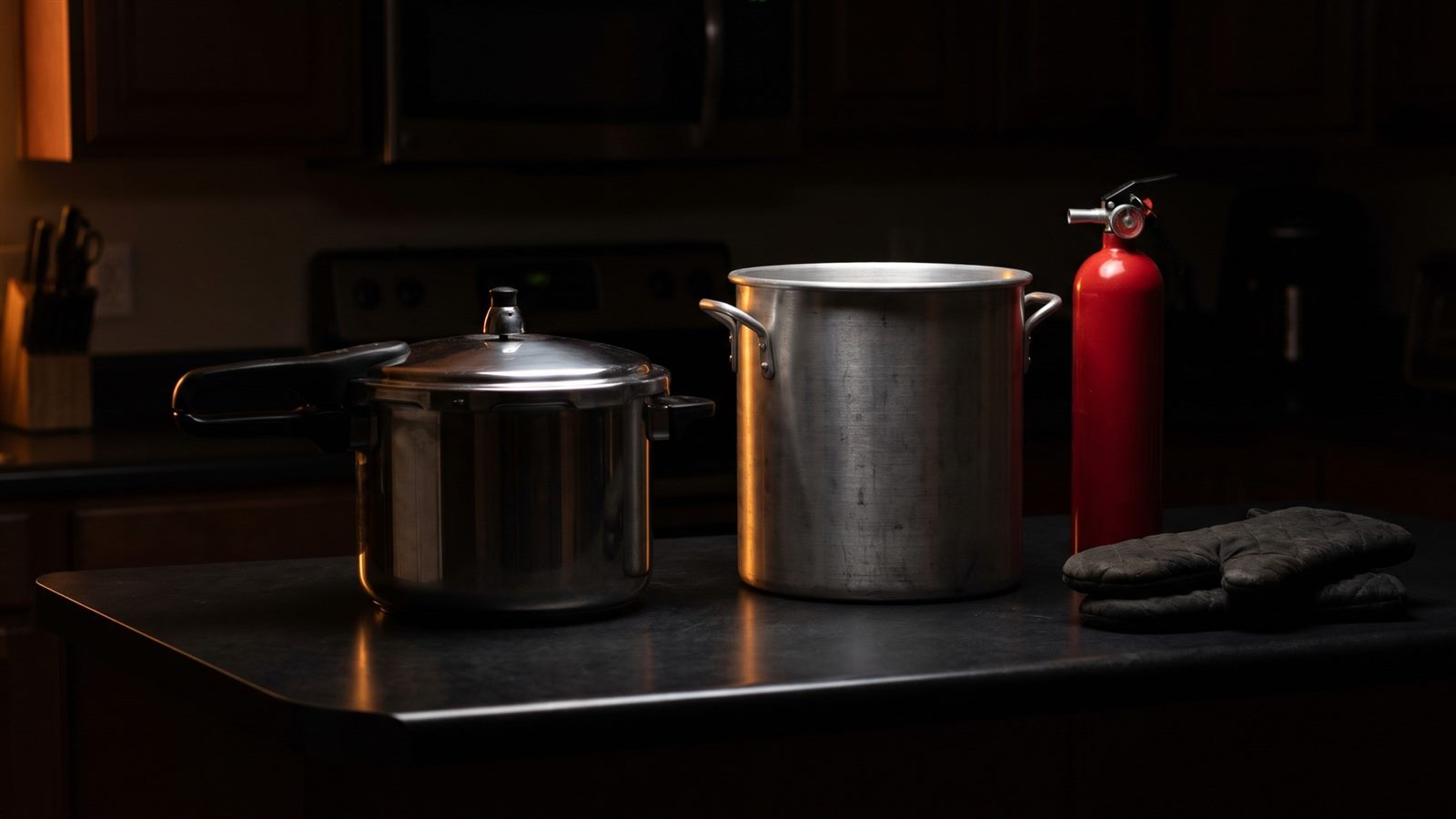
Thanksgiving week puts hot oil, steam and heavy pots in kitchens and driveways all over Miami-Dade. Most dinners go fine. Some do not. A fryer tips, a lid lets go, and a family holiday turns into a trip to the burn unit.
This is a safety guide first. Below you will find what makes these appliances risky, how to cook with them more safely, what Florida law generally says when a product is the problem, and what to do if someone gets hurt.
What makes turkey fryers and pressure cookers risky?
Both appliances pack a lot of heat into a small space.
Turkey fryers hold several gallons of oil at very high temperatures. Three things go wrong again and again: the pot overflows when the bird goes in, the bird is still frozen or wet, or the fryer sits on uneven ground and tips. Hot oil and open flame, or a hot element, do not leave much room for error.
Pressure cookers trap steam to cook food quickly. They are built so the lid will not open while the pot is under pressure. When that lock fails, or when the lid is closed wrong, hot contents can escape fast.
How can I use them more safely?
Federal fire-safety agencies publish simple rules for turkey fryers. The big ones:
- Thaw the turkey completely and dry it before it touches oil.
- Fry outdoors, on a sturdy, level surface, at least 10 feet from the house, not under the roof eaves, and away from the garage, a deck or anything that burns. Do not move the fryer once it is in use.
- Never leave the fryer unattended, and keep children and pets at least 3 feet away.
- Do not overfill the pot. If the fryer's instructions do not say how much oil to use, put the turkey in the empty pot, add water until it is just covered, remove the bird, and mark the water line. Empty and dry the pot. That line is how much oil to use.
- Lower and raise the bird slowly to cut down on splatter. If the oil starts to smoke, turn the burner off.
- Keep a fire extinguisher nearby and know how to use it. Never use water on a fryer fire. If a fire starts, call 911.
For pressure cookers, follow the maker's manual. Check the gasket and the vent, do not overfill, and let the pressure drop fully before opening. Never force a lid.
Is it the product or the cook?
Fair question, and an honest one. Sometimes the person got careless. Sometimes the appliance failed even though it was used the way the instructions said.
Florida law generally treats a product as defective in one of three ways:
- Design defect. The way the product was designed made it unreasonably dangerous, even if it was built exactly to plan. A fryer that is easy to tip is an example of the kind of question lawyers and engineers look at.
- Manufacturing defect. This particular unit came off the line wrong. A lid lock that was assembled badly is the kind of example people think of.
- Warning defect. The product needed a clear warning or instruction about a danger, and it did not have one, or the one it had was not adequate.
Under Florida law, a company in the chain that put the product into the world may be responsible, not only the one that made it. That can include the maker, a distributor and a seller.
Fault can also be shared. If a cook ignored a clear instruction, that may be weighed against the claim.
Every case turns on its own facts. This article is general information, not legal advice about your situation.
What should I do if I am burned?
Take these steps in this order.
- Get medical care first. Call 911 for serious burns. Cool a burn with cool running water and do not use ice. Get hospital care for burns that are large, or that are on the face, neck, hands, feet, joints or genitals.
- Keep the product. Do not throw it out. Do not clean it, repair it, or try it again. Keep the lid, the gasket, the box, the manual and any pieces that broke off.
- Keep the packaging, the receipt and any warranty card. They show what you bought, where and when.
- Take photos, from several angles, of the product, the spot where it happened, and your injuries. Do this as soon as you safely can, and again as the injury heals.
- Do not return it to the store and do not send it to the manufacturer. If the product leaves your hands, the evidence may be lost or changed. If a company asks for the product, you can say you are keeping it safe until you have spoken with a lawyer.
- Check for recalls at CPSC.gov. Write down the recall number if your model is listed.
- Report it to the Consumer Product Safety Commission at SaferProducts.gov.
- Write down what happened while it is fresh: who was there, what you were doing, what the instructions said.
Is there a deadline to act?
Yes. Florida sets time limits for injury claims, and a recent change to the law shortened some of them. There is also a separate outer limit on how long after a product was sold some claims can be brought. Because the rules depend on the kind of claim, do not wait.
Where can I learn more?
Read our products liability guide for how these claims work in general, and our personal injury overview for the other kinds of injuries we handle.
Hurt by a product? Call us to talk about your options.
If a holiday appliance injured you or someone you love, we can listen and explain where you stand. The consultation is free.
(305) 209-0384 · Open 24/7 · Se habla español
This article is general information, not legal advice, and does not create an attorney-client relationship. Every case is different.